Tampilkan postingan dengan label English Lessons. Tampilkan semua postingan

Kamis, 13 Desember 2012

Posted by Unknown | File under :
Procedure text is a text to describe how to make or doing something

Generic Structure of Procedure Text:
1. Goal/Aim (Tujuan)
2. Materials (Bahan-bahan)
3. Steps/Methods (Langkah-langkah)

Example procedure text  about how to make something:

The Procedure of Making Meatballs


 ingredients :
  • 1 kilo of very fine minced meat (preferably beef)
  • 2 eggs
  • 300 grams of tapioca-flour
  • 4-8 cloves of garlic
  • 1 red onion
  • 1 teaspoon of white pepper
  • 2 teaspoons of salt

Steps :
  • First of all,mix garlic, red onion, salt, and white pepper in a mortar or mixer.
  • Second step, mix the spice-mixture with the eggs, the tapioca-flour and the minced meat.
  • After that, use your fingers, add a cup of water, and keep on working until the mixture feels soft and smooth.
  • Then, boil some water in a rather large pot, at least about 2 liters.
  • Next step, start rolling the mixture into small meatballs.
  • Finally, lower the meatballs into the boiling water. When they float up to the surface the meatball are ready to serve.
Posted by Unknown | File under :
 

FORM

[VERB] + s/es in third person
Examples:
  • You speak English.
  • Do you speak English?
  • You do not speak English.

USE 1 Repeated Actions


Use the Simple Present to express the idea that an action is repeated or usual. The action can be a habit, a hobby, a daily event, a scheduled event or something that often happens. It can also be something a person often forgets or usually does not do.
Examples:
  • I play tennis.
  • She does not play tennis.
  • Does he play tennis?
  • The train leaves every morning at 8 AM.
  • The train does not leave at 9 AM.
  • When does the train usually leave?
  • She always forgets her purse.
  • He never forgets his wallet.
  • Every twelve months, the Earth circles the Sun.
  • Does the Sun circle the Earth?

USE 2 Facts or Generalizations


The Simple Present can also indicate the speaker believes that a fact was true before, is true now, and will be true in the future. It is not important if the speaker is correct about the fact. It is also used to make generalizations about people or things.
Examples:
  • Cats like milk.
  • Birds do not like milk.
  • Do pigs like milk?
  • California is in America.
  • California is not in the United Kingdom.
  • Windows are made of glass.
  • Windows are not made of wood.
  • New York is a small city. It is not important that this fact is untrue.

USE 3 Scheduled Events in the Near Future


Speakers occasionally use Simple Present to talk about scheduled events in the near future. This is most commonly done when talking about public transportation, but it can be used with other scheduled events as well.
Examples:
  • The train leaves tonight at 6 PM.
  • The bus does not arrive at 11 AM, it arrives at 11 PM.
  • When do we board the plane?
  • The party starts at 8 o'clock.
  • When does class begin tomorrow?

USE 4 Now (Non-Continuous Verbs)


Speakers sometimes use the Simple Present to express the idea that an action is happening or is not happening now. This can only be done with Non-Continuous Verbs and certain Mixed Verbs.
Examples:
  • I am here now.
  • She is not here now.
  • He needs help right now.
  • He does not need help now.
  • He has his passport in his hand.
  • Do you have your passport with you?

ADVERB PLACEMENT

The examples below show the placement for grammar adverbs such as: always, only, never, ever, still, just, etc.
Examples:
  • You only speak English.
  • Do you only speak English?

ACTIVE / PASSIVE

Examples:
  • Once a week, Tom cleans the car. Active
  • Once a week, the car is cleaned by Tom. Passive

Posted by Unknown | File under :
 
SHAPES Simple Straight sided shapes
Rectangle
Square
Triangle
Simple Rounded shapes
Circle
Oval
3D shapes
Cone
Cube
Cylinder
Pyramid
Sphere
Mathematical shapes
Parallelogram
Pentagon – 5 sides
Octagon – 8 sides
Miscellaneous shapes
Diamond
Heart


There are several kinds of shapes you will learn in elementary school; this page will provide you with the names and examples of each one.

Circle

A round shape, drawn like this:

Triangle

A shape with three sides. Sometimes the sides are equal—sometimes they aren’t. Their names are sometimes different depending on the length of the sides. We will show you the common ones:

Equilateral triangle—this triangle has 3 equal sides.
Isosceles triangle—this triangle has 2 equal sides.
Scalene triangle—this triangle has no equal sides.

Square

A box shape, with four equal sides—opposite sides are parallel, drawn like this:

Parallel means non-intersecting. For example, parallel lines means that if the two lines kept going forever, they would never cross over each other—they would always be an equal distance apart.

Rectangle

Another box shape, with two sets of equal sides. Equal sides are opposite each other. The sides are parallel to each other. It’s drawn like this:

Trapezoid

Another 4 sided shape, with one set of parallel lines (the other set of lines is not parallel), drawn like this:

Pentagon

A shape with five sides. They can be drawn many different ways, but these are the most common:

The pentagon on the left is known as a regular pentagon, because all of its sides are the same length. The one on the right is also a commonly known pentagon, shaped like a house.

Hexagon

A shape with six sides, drawn like this:

Heptagon

A shape with seven sides, drawn like this:

Octagon

A shape with eight sides, drawn like this:

You’ll notice that the octagon is the shape they use for stop signs.

Nonagon

A shape with nine sides, drawn like this:

Decagon

A shape with 10 sides, drawn like this:

Dodecagon

A shape with 12 sides, drawn like this:

Polygons

All of these shapes are polygons. A polygon is a shape made of lines that could be colored in (all the lines meet and it has a “middle”).
Most of what you will be asked to do with these shapes is recognize them and draw them, so memorize how many sides they have, what they look like, etc. Other things may include calculating the area and/or perimeter of these shapes. If you’re trying to find area or perimeter, read our page on Area and Perimeter.


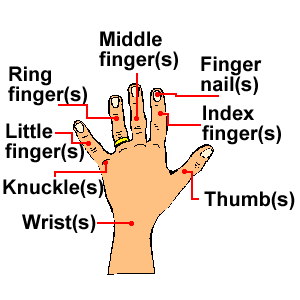
PART OF BODY


shoulder (s) = bahu
neck = leher
arm (s) = lengan
chest = dada
hand = tangan
knee = lutut
leg = kaki (dari pangkal paha ke bawah)
foot = kaki
2 feet = 2 kaki
stomach =  perut
nipple = puting
navel = pusar
throat = tenggorokan


head = kepala
elbow (s) = siku
back = punggung
bottom = pantat 
thigh (s) = paha
calf/ calves = betis
heel(s) = tumit


ankle(s) = mata kaki
toe nail(s) = kuku jari kaki
big toe(s) = ibu jari kaki
little toe(s) = jari kelingking kaki
heel(s) = tumit


finger(s) = jari-jari tangan
finger nail(s) = kuku jari-jari tangan
little finger(s) = jari kelingking
ring finger(s) = jari manis
index finger(s) = telunjuk
middle finger(s) = jari tengah
knuckle(s) = tulang buku jari/buku jari
wrist(s) = pergelangan tangan.
 
Posted by Unknown | File under :
 
Formula:
(+) S + have/has + V3
(-)  S + have/sas Not + V3
(?) Have/has + S + V3 + ?
Here are some examples of the present perfect tense:
subject
auxiliary verb

main verb

+
I
have

seen
ET.
+
You
have

eaten
mine.
-
She
has
not
been
to Rome.
-
We
have
not
played
football.
?
Have
you

finished?

?
Have
they

done
it?
When we use the present perfect tense in speaking, we usually contract the subject and auxiliary verb. We also sometimes do this when we write.
I have
I’ve
You have
You’ve
He has
She has
It has
John has
The car has
He’s
She’s
It’s
John’s
The car’s
We have
We’ve
They have
They’ve

They’ve

Posted by Unknown | File under :

Simple Past

[VERB+ed] or irregular verbs
Examples:
  • You called Debbie.
  • Did you call Debbie?
  • You did not call Debbie.
Complete List of Simple Past Forms

USE 1 Completed Action in the Past


Use the Simple Past to express the idea that an action started and finished at a specific time in the past. Sometimes, the speaker may not actually mention the specific time, but they do have one specific time in mind.
Examples:
  • I saw a movie yesterday.
  • I didn't see a play yesterday.
  • Last year, I traveled to Japan.
  • Last year, I didn't travel to Korea.
  • Did you have dinner last night?
  • She washed her car.
  • He didn't wash his car.

USE 2 A Series of Completed Actions


We use the Simple Past to list a series of completed actions in the past. These actions happen 1st, 2nd, 3rd, 4th, and so on.
Examples:
  • I finished work, walked to the beach, and found a nice place to swim.
  • He arrived from the airport at 8:00, checked into the hotel at 9:00, and met the others at 10:00.
  • Did you add flour, pour in the milk, and then add the eggs?

USE 3 Duration in Past


The Simple Past can be used with a duration which starts and stops in the past. A duration is a longer action often indicated by expressions such as: for two years, for five minutes, all day, all year, etc.
Examples:
  • I lived in Brazil for two years.
  • Shauna studied Japanese for five years.
  • They sat at the beach all day.
  • They did not stay at the party the entire time.
  • We talked on the phone for thirty minutes.
  • A: How long did you wait for them?
    B: We waited for one hour.

USE 4 Habits in the Past


The Simple Past can also be used to describe a habit which stopped in the past. It can have the same meaning as "used to." To make it clear that we are talking about a habit, we often add expressions such as: always, often, usually, never, when I was a child, when I was younger, etc.
Examples:
  • I studied French when I was a child.
  • He played the violin.
  • He didn't play the piano.
  • Did you play a musical instrument when you were a kid?
  • She worked at the movie theater after school.
  • They never went to school, they always skipped class.

USE 5 Past Facts or Generalizations


The Simple Past can also be used to describe past facts or generalizations which are no longer true. As in USE 4 above, this use of the Simple Past is quite similar to the expression "used to."
Examples:
  • She was shy as a child, but now she is very outgoing.
  • He didn't like tomatoes before.
  • Did you live in Texas when you were a kid?
  • People paid much more to make cell phone calls in the past.

IMPORTANT When-Clauses Happen First

Clauses are groups of words which have meaning but are often not complete sentences. Some clauses begin with the word "when" such as "when I dropped my pen..." or "when class began..." These clauses are called when-clauses, and they are very important. The examples below contain when-clauses.
Examples:
  • When I paid her one dollar, she answered my question.
  • She answered my question when I paid her one dollar.
When-clauses are important because they always happen first when both clauses are in the Simple Past. Both of the examples above mean the same thing: first, I paid her one dollar, and then, she answered my question. It is not important whether "when I paid her one dollar" is at the beginning of the sentence or at the end of the sentence. However, the example below has a different meaning. First, she answered my question, and then, I paid her one dollar.
Example:
  • I paid her one dollar when she answered my question.

ADVERB PLACEMENT

The examples below show the placement for grammar adverbs such as: always, only, never, ever, still, just, etc.
Examples:
  • You just called Debbie.
  • Did you just call Debbie?

ACTIVE / PASSIVE

Examples:
  • Tom repaired the car. Active
  • The car was repaired by Tom. Passive 


Continuous Tenses

The continuous tenses (incomplete tenses) include:
  • Present Continuous ("I am choosing")
  • Past Continuous ("I was choosing")
  • Future Continuous ("I will be choosing")
They are formed with the progressive (continuous) aspect.
This aspect indicates that an action or state, past, present, or future, was, is or will be unfinished at the time referred to.
The continuous aspect is formed by the auxiliary verb "to be" and the -ing form (the present participle).

Continuous + perfect

If we combine the continuous and perfect tenses, we get:
  • Present Perfect Continuous ("I have been choosing")
  • Past Perfect Continuous ("I had been choosing")
  • Future Perfect Continuous ("I will have been choosing")
Posted by Unknown | File under :
Function of Recount Text:
Recount text’s function is to tell about past events.
Parts (Generic Structure) of Recount Text:
1.      Orientation
Orientation tells the readers who was involved in the story, what happened, where the story took place and when it happened.
2.      A series of Events
A series of events tell the sequence of events. These events are described in a chronological order.
3.      Reorientation
Reorientation tells the summarizes the event.
Characteristics of Recount Text:
·         Use simple past tense.
Formula:
+ Subject + Verb 2/Verb past + object/complement
- Subject + did not + Verb 1/Verb base + object/complement
? Did + Subject + Verb 1/verb base + object/complement + ?
·         Always started by past adverbial of time
Examples:
-Two weeks ago,
-Last week,
-Last holiday,
-Yesterday,
-One day,
-Nine years ago, etc.
Example 1:
Barbecue in The Park
            Last Sunday, we want to the park. David’s family invited us to a barbecue party in the park. We lived nearby so we just walked there.
            When we got the park, there were not many people yet. David’s family was already there. They arrived there early to get the best picnic spot withn an electronic barbecue grill nearby. When I arrived, they were cleaning the barbecue. They made sure the barbecue was clean. When it was clean, they turned the barbecue on by pushing the button. The electric stove turned on and the metal plate became hot.
            David’s mother put some cooking oil on the metal plate, and after that put some sausages, beef steaks, and some onions on the barbecue. Meanwhile, David’s father was preparing the bread, butter, and the drinks.
            While waiting for the meat to cook, David and I joined our friends playing football. When we got tired, we stopped and enjoyed the sausages, steaks, and some cold softdrinks. The food was delicious. I think David’s mother is one of the best cooks in the world.
Example 2 :
A Trip to Jogyakarta
Yogyakarta is one of famous tourism area in Indonesia. Many tourists, whether they are local or international tourists, like visiting this city and So do I. I had an opportunity to visit Yogyakarta in December 2011. I went to Yogyakarta for three days and two nights with my students. There were around fifty students joining this trip. We left from Tangerang, Banten by a bus. After spending twelve hours in the bus, we arrive in Jatijajar Cave as our first visit on Saturday morning.Jatijajar Cave is located around 21 kilometers from Gombong and 42 kilometers from Kebumen.
In Jatijajar, We had breakfast and then enterred the inside of the cave. In the cave, we enjoyed the statues depicting Raden Kamandaka. Some students took pictures in front of the statues. At around 10 A.M, we left from Jatijajar Cave and went ahead to Kaliurang as our accomodation place.
At around 5 P.M, we arrived in the hotel and all the participants took a rest until evening. After having dinner, around 8 P.M, we had an art performance presented by the students. We invited the students to perform their skills in front of others. The performance was quite exciting because there were sing songs, dance performaces, magic show and jingle competitions. The organizing committe also gave many dorr prizes for participants. It lasted about 3 hours until 11 P.M.
Sunday was the most amazing day for us because we visited some great places; Borobudur Temple, Parangtritis Beach, and  Malioboro Street. Our firstdestination was Borobudur Temple, We all felt excited to visit this world heritage because we had a chance to see the geatest temple in the world. In Borobudur Temple, the students had to interview the native speakers in groups. Besides interviewing the native speakers, the students also took pictures in front of the stupas and many native speakers. 
After enjoying Borobudur temple for almost four hours, we headed to parangtritis. In Parangtritis Beach, the students did some group contest, such as tug of war. All groups seemed enjoy doing the contest. We didn’t stay in the beach for a long time because it was already dawn.
Malioboro Street was our next destination. In this famous street, we had dinner and went shopping. Many students bought T-shirt called Dagadu T-Shirt and famous cakes “bakpia”. Aroung 11 P.M on Sunday, we came back to the hotel for a rest and on Monday Morning we returned to Tangerang.
A Trip to Jogyakarta was an amazing trip for us and we had a lot of nice memories there. We hop that we will have the same trip oneday.
Posted by Unknown | File under :
 
1.      The Purpose of Narrative Text
The purpose of narrative text is to amuse or entertain the readers.
Narratives deal with problematic events which lead to a crisis or turning point of some kind, which in turn a resolution.
 
2.      The Generic Structure (Parts) of Narrative Text
There are three parts of narrative text, those are:
1)     Orientation
It sets the scene and introduces the participants of the story.
2)     Complication
It shows when the crisis arises.
3)     Resolution
It shows when the crisis is resolved, for a better or worse condition.
Note:
The structure of narratives occurs in the text variously. A text may have only one complication and resolution, but another text may have more than one complication and resolution.
 
3.      The grammatical features of narratives
There are some grammatical features of narratives, those are:
1)     Use of adjectives to build noun groups to describe the people, animals, or things in the story, such as …. a nice, diligent and kind-hearted man;
2)     Use of time connectives and conjunctions to sequence events through time, such as however, although, later, then;
3)     Use of adverbs and adverbial phrases to locate the particular events, such asonce upon a time, long time ago;
4)     Use of past tenses, such as Aji Saka went to the kingdom, measured the size of the turban ….;
5)     Use of action verbs to indicate the actions, such as fleed, explained, provided, smashed; and
6)     Use of saying and thinking verbs to indicate what characters are feeling, thinking, or saying, such as told, realized, decided.
 
Example of Narrative Text:
 
The Ducks and the Fox
            One day, two ducks walked along the road to go to the lake for their swim. In the middle of the road, they met Mr. Fox. He sat under the tree.
            “Hello, sisters. Where are you going?” asked Mr. Fox.
            “Good morning, Mr. Fox. We are going to the lake over there. We want gto swim. Would you like to join us?” asked the ducks.
            “No, thanks. Do you both come along here every day?” asked Mr. Fox.
            “Yes, we always walk here every morning,” said the ducks.
            “Delicio ….I….I….mean nice to see you both,” said Mr. Fox.
            The next day, the first duck said, “Are we going to swim today? I bet that Mr. Fox is waiting for us and he has a bad plan.”
            “I know. I have a plan for him too,” said the second duck.
            On their way, they met Mr. Fox again.
            “Hello, sisters. Going to swim again?” asked Mr. Fox.
            “Yes, we are. Why don’t you take us to the lake and protect us from bad animals?” said the second duck.
            “Of course. It’s my pleasure,” replied Mr. Fox.
            “This is an easy way to have a free lunch. I have a big bag with me now,” thought Mr. Fox.
            Three of them walked to the lake and sang some songs.
            “When I say run, let’s run fast together,” said the second duck, “Run!!!!”
            They ran so fast and jumped into the lake. Mr. Fox jumped upon them, but he forgot that he could not swim. So, Mr. Fox drowned in the lake. He failed to get his free lunch.
 
Posted by Unknown | File under :
1)     Command
There are some giving instruction in command form that usually we use in the dialy life, those are:
Verb + object
  • Examples:
  • Watch out, come here.
  • Eat your meal.
  • Switch off the phone in class.
  • Please + verb + object
  • Examples:
  • Please clean your room now.
  • Please wash your hand first.
  • Please press the button gently.
  • Please read the rules first.
  • Please read the direction for use first.
Verb + object + please
  • Examples:
  • Wash this towel, please.
  • Sit down, please.
  • Close the window, please.
  • Open the door, please.
  • Remove the pan from the heat, please.
Be + adjective
  • Examples:
  • Be yourself.
  • Be a good boy/girl.
  • Be strong.
  • Be happy.
  • Be polite.
  • Be careful.
  • Be gentle.
 2)     Prohibition
There are some giving instruction in prohibition form that usually we use in the dialy life, those are:
Don’t + verb infinitive without to
  • Examples:
  • Don’t eat the fried chicken in the cupboard.
  • Don’t close it!
  • Don’t open the door!
  • Don’t eat that!
  • Don’t approach!
  • Don’t disturb me now!
  • Don’t touch my hand!
Don’t + be + adjective
  • Examples:
  • Don’t be noisy.
  • Don’t be lazy.
  • Don’t + verb + object + please
  • Examples:
  • Don’t close the window, please.
  • Don’t make me sad anymore, please.
  • Don’t treat me bad, please.
Would you mind not + verb-ing + object
  • Examples:
  • Would you mind not reading my diary.
  • Would you mind not enter my room.
  • Would you mind not use my gadget.
  No + verb-ing
  • Examples:
  • No smoking!
  • No swimming!
  • No parking.
  • No fishing.
 Example
 Read the following dialog.
Galih   : Thalita, have you sliced the garlic?
Thalita : Yes, I have. So, what sould I do then?
Galih   : Then, put one slice on the glass, please.
Thalita : O.K. It’s done.
Galih    : Good. Now, give me the glass. Let’s observe it under the microscope.
Thalita  : Sure.
Pay attention to the sentences in bold. Those sentences express that the boy orders or instructs the girl to do as he says.
            Instructions usually begin with infinitive without to (verb base).
Remember! To make an instruction sounds more polite, use the word ‘please’ at the beginning or at the end of the instruction.
Posted by Unknown | File under :
 
1.The Definition of Gaining Attention
Gaining attention is a way or expression that is spoken so that other people will pay their attention to what we want to.

2.Expressions We Can Use to Ask Other People Attention
Here are some expressions we can use to ask aother people attention.
1)     Attention, please!
2)     May/can I have your attention, please?
3)     Look!
4)     Look here!
5)     Excuse me!
6)     Excuse me, look here!
7)     Listen to me, please.
8)     Waiter?
9)     I’m sorry, but ….
10)Wow, really?
11)Excuse me, look here, please.
12)I’m listening.
 
Examples
Mr. Edward    : Attention class!
Now we will discuss about gaining attention.
Pupil               : Yes, Sir.
Mr. Edward    : Ehmm, hey you! Who sits in the corner, please be quite cause we will start our lesson
                          for today.
Joan                : Sorry, I will not do the same thing twice.
Mr. Edward    : That’s better.
 
Posted by Unknown | File under :

1.The Definition of Happiness Expression: 
Happiness expression is an expression that is used to show that someone or people are glad have excited feelings.

What is happiness?

-It is important to first understand that the term “happiness” refers to the emotion, mood, and state of happiness; however researchers generally study the more enduring “state”.

-Expression happiness is used to express happiness feelings when we are successful to do something.

2.Expressing Happiness

  Here are some expressions to show happiness

ü  That’s wonderful!
ü  That’s fantastic!
ü  That’s good!
ü  I find it very exciting.
ü  Good job!
ü  Great!
ü  Fantastic!
ü  Terrific!
ü  Hooray!
ü  Yippee!
ü  What a great idea!
ü  It sounds like fun.
ü  It is good news.
ü  I’m pleased/delighted about it.
ü  It’s the best thing I’ve heard …. (examples: ever, for a long time)
ü  I’m satisfied with ….
ü  Congratulations!
ü  I’m very happy because/on …. (examples: you success, your graduate)
ü  Well done.
ü  My life’s fun of happy day.
ü  You really make me happy.
ü  I like …. (example: to know that)
ü  I love …. (example: to hear that)
ü  It was great.

Examples

  Read the dialogs.

  Dialog 1
Mrs. Hans       : How was your school today, dear?
Tasya              : It was great, Mom.
Mrs. Hans       : That’s good. By the way, Annie, your niece, is in Bandung now.
Tasya              : Annie? When did she come? How was her study in Singapore?
Mrs. Hans       : She arrived here yesterday, and about her study, she did it well.Now, she is having a semester holiday in Indonesia.You know what, she has brought some books.
Tasya              : What books, Mom?
Mrs. Hans       : Well, just have a look yourself.
They are on the table in the reading room.
Tasya              : Yippee!
Mrs. Hans       : Well, don’t forget to find her to say thank you.
Tasya              : I will.

Dialog 2
Grace              : Hello, Anthony! I just knew that you have a cat.
Anthony         : Hello Grace! I do. Mr. Ridwan gave me this cat two days ago. I’m so happy about it. You                 :know, I really want to have a cat.
Grace              : It is really pretty.
            The boy says, “I’m so happy about it.” because he has got a cat. The sentence is used to express happiness.
Posted by Unknown | File under :
 
[•]The definition of Advertisement:
Advertisement is promotion of goods, services, companies, and ideas that must be paid by a sponsor.
[•]Function of Advertisement:
-Promotion
-Communication
-Information
[•]Language of Advertisement:
-Using the correct or suitable words
-Using positive expression
-Using the interesting and suggestive expression
-Text of advertisement should be directed to the goals
[•]In making Advertisement, keep the following points:
The contents of advertisement must objective and honest
-Short and clean
-Does not allude other group or producer
-Use word that polite and logical
-Attract attention
[•]Kinds of Advertisement:
-Family advertisement
-Invitation advertisement
-Sponsored advertisement
-Requested advertisement
-News advertisement
-Announcement advertisement
-Goods advertisement
-Merit advertisement 
-Offer advertisement
-Article advertisement
Posted by Unknown | File under :

1. Definition Sympathy expression is an expression or feeling of pity and sorrow when we know and see someone or people are unlucky or have trouble and in bad condition. By sympathy expression we want to show our concern of corefuiness or other people’s condition.
 
2. How to express sympathy We express sympathy expression directly to him / her orally or use a letter or card by post also by short message service (SMS), television, radio, E-mail, and newspaper if he/she who go trouble is from use.
 
3. example of Expresing Sympathy : a. If you want to respond to good news, you can use the following expressing:
     How nice . . . !
      How exciting !
      I’m pleased to hear that.
      I’m (very) glad to hear that.
      Oh, is it true?
      Oh, really?
       
b. If you want to respond to bad news, you can use the following expressing:
         I’m sorry to hear that.
        Oh, dear. I know how it feels.
        What a terrible situation for you ! 
        Poor you.
        What a shame !
        You must be upset.
        Please accept my condolences !
        You have my deepest sympathy.
        What a terrible situation !
        That is a pity/shame!
        Oh, that’s awful
Posted by Unknown | File under :
INVITATION
Invitation is the way to invite someone or more to go to place or to do something.
Purpose is to invite someone or more to come to an event.
There are two types of Invitation :
•Formal Invitation
•Informal Invitation
   [•]Formal & Informal Inivtation
Formal invitation is usually originate from institutes, companies and a kind of it. Normally formal invitation is written invitation.
Informal Invitation is personal invitation given to a friend, family, etc. Informal invitation can be written invitation and verbal invitation.
[•]Example of Formal Inivtation
 
 [•]Example of informal Invitation
 
[•]Extending (Expressions of Inviting)
  I would like you to come to my house.
Would you like to come to my restaurant?
How would you like to go camping with us next month?
If you are not busy, please try to come to my office.
Are you free this evening? 
[•]Accepting an Invitation 
I’d love to
I like tha
That sounds great
Thank you for the invitationThat would be wonderful
[•]Declining / Refusing
  I’d love to, but I can’t 
  I’m really sorry because I can’t come 
  Sorry, I’m really busy
  I’d love to, but I won’t be able to
  I’d love to, but I don’t think I can
  Sorry, I can’t go with you
  Sorry, that would not be possible . Thanks anyway
[•]Dialogue of Invitation 
Doni  : Would you like to go with me to  Gray’s birthday party? 
Sean  : Sure. I’d like to.
Doni  : Great!!
Sean  : What time is the party? 
Doni  : The party is at 07.00 pm, so I will pick you up at 06.30 pm.
Sean  : Okay. Do I need to bring a present with me? 
Doni  : No, I’ll take care of it.
Sean  : Okay, then. See you. 

Posted by Unknown | File under :
 
The Definition of Appointment
  Appointment is a kind of expression which is used to conduct an appointment.
Expressions We Can Use to Make and Accept an Appointment  
  Here are some expressions we can use to make and accept an appointment.
[•]Making an Appointment
 1.Will you go out with me ….? (example: tonight)
 2.I’d like to make an appointment with …. (examples: you, him, her)
 3.Will you pick me up at ….? (example: tomorrow morning 2 p.m.)
 4.Can I come and see you?
 5.Can we meet at …. (examples: Kitchen Restaurant, Hotel) 
[•]Accepting an Appointment
1.Okay. I’ll be there on time.
2.No problem. I’m free …. (examples: on Sunday, at that day, at that time)
3.Sure, I love it.
4.Good idea.
5.Definitely!
6.All right, see you there.
 •Expressions We Can Use to Cancel an Appointment
1.I’m sorry. I can’t meet you today. I have to see my dentist. Can we reschedule?
2.We’re terribly sorry we have to cancel our appointment. Mr. Tanaka’s flight is delayed for two hours.
3.I’m afraid I have to put off put appointment because I have an urgent business to do.
4.Sorry. I can’t meet you this weekend since I have another appointment.
5.Sorry, I can’t meet you tomorrow. I’m busy at that day.
•Examples
[-]Dialog 1 (Accepting an Appointment)
Daniela           : Let’s see Aunt Michelle in the hospital.
Cliff                : I’m sorry, not now.I have to finish the homework and send it to Ms. Rita.
Daniela           : What about tomorrow afternoon at 4 p.m.?
Cliff                : Tomorrow afternoon at 4 p.m.? O.K.
The sentences in bold are used to make and accept an appointment. In the dialog, Daniela makes an appointment with Cliff to see Aunt Michelle in the hospital tomorrow afternoon at 4 p.m. Then, Cliff accepts the invitation by saying, “Tomorrow afternoon at 4 p.m.? O.K.”.
[-]Dialog 2 (Cancel an Appointment)
Rose    : Hello Eva. I’m glad to meet you here. I want to say something with you.
Eva      : Are you? Is there something wrong?
Rose    : Yes. I have to postpone our appointment to visit Lelly this afternoon.
               You know, I have to finish my assignment and collect it tomorrow. I’m sorry.
Eva      : That’s O.K. Maybe some other time.
The sentence in bold is used to cancel an appointment. In the dialog, Rose has to cancel the appointment because she has an assignment to finish. Although Rose cancels the appointment, Eva is alright. She says that she’s O.K. with that.
Posted by Unknown | File under :


Archive |drizkyg